By B.L. Jordan, Policy and Trades Program Manager, Providence Preservation Society, Providence, Rhode Island
As someone who didn’t necessarily think of myself as a public historian, this conference has decidedly changed my mind.
I am the policy and trades training programs manager at Providence Preservation Society, and I was lucky enough that the conference was in our backyard. I was honored to receive the Douglas Evelyn Diversity Fellowship, named in honor of Douglas Evelyn, AASLH president from 1992- 1994, and recognizing Evelyn’s strong support of AASLH’s professional development mission. My work with PPS has increasingly led me to this belief: If we want to change law and policy
and advocate for more just, community-driven, and equitable solutions, we must understand our past to better ground our choices in the present.
This year’s joint conference was named “The Work of Revolution,” bringing together public historians, archivists, museum curators, scholars, historic preservationists, and others working across the field. The conference offered an opportunity to think collectively about where public history has been, where it might be going, and how it can inform positive and lasting change in the future.
This conference begged a few questions of its attendees: What does it mean to do the “work of revolution” as a public historian? Who gets to decide what public history is and who participates in this revolutionary work?
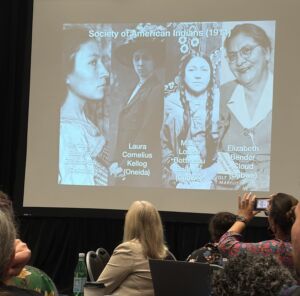
These questions stayed with me, speaker to speaker, panel to panel. The keynote was presented by Yale Professor Ned Blackhawk, author of The Rediscovery of America: Native Peoples and the Unmaking of U.S. History, about twentieth-century activism by individuals, like Oneida Nation member and leader Laura Cornelius Kellogg. But it was the speaker before Professor Blackhawk that I want to highlight. Narragansett Nation Councilwoman Mars-Martins gave the definition of revolution that has stayed with me: “Revolution,” Mars-Martins said, “is the everyday work of remembering.”
During the conference, I sought out sessions to dig into where I, a historic preservationist, might fit in the public history landscape. One of the most impactful panels was entitled “Public History at 50: Past, Present, and Future.” The panel tried to answer the technical question, “What is public history?” So much of what was discussed helped frame my own thinking about what I do. It’s a set of values and a methodology, unique in its observations. One panelist, Omar Eaton Martinez, described public history as “for the people, by the people.” A few of the panelists concluded that the ambiguity and indefiniteness of public history help keep it nimble, and thus help to keep it open to more people who can then define themselves as public historians.
After the panel, I was left with the thought that history is not simply about knowing what happened. It is also about deciding how we communicate that history to a wider audience and how we invite people to actively participate in it. The “public” portion of “public historian” highlights a deep commitment to community and a history practice that is rooted in public service. The conversations between sessions offered opportunities to exchange ideas and learn from people working in a variety of institutional and community settings. Those conversations reinforced that this field is deeply dependent on relationships for knowledge sharing and resources.
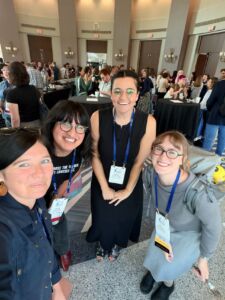
Trish Denton, Michael Lopez, B.L. Jordan, Eliza Callahan. Picture courtesy of Trish Denton.
My favorite session was one called “Urgent Legal Issues for the Public History Practitioner.” The panel included Marion Werkheiser, a founding partner at Cultural Heritage Partners. The law firm is a key organizer for a national grassroots pushback on the destruction of National Historic Preservation Act regulations. Marion emphasized this: “Democracy rests on history. . . when the truth is erased, people cannot govern themselves.” She moved through the expected draft changes and why they are harmful to Tribal Nations, communities, and our collective understanding of public history. I left the conference certain that the most important takeaway was not simply what public history is doing now, but how the field is evolving through the choices it collectively takes. Ultimately, the meaning of “the work of revolution” is the accumulation of everyday choices. Choices to remember, listen, ask more questions, build stronger relationships, broaden the historical record to include those systematically removed, and to imagine new possibilities for how history can serve the public.