What does it mean to experience history not in a museum, but on a street? An Urban neighborhood filled with smells, sounds, art and voices of the local residents?
Rhode Island Latino Arts (RILA) tries to answer these questions. Founded in 1988 as the Hispanic Heritage Committee, today RILA is Rhode Island’s leading nonprofit organization exclusively dedicated to the promotion, advancement, development, and cultivation of Latino arts. Their mission is to promote, encourage and preserve the art, history, heritage and cultures of Latinos in Rhode Island. They celebrate and promote Latino art & artists through their Rhode Island Latino Artists Network events, including National Hispanic Heritage Month, by partnering with local community organizations, including schools, libraries, museums and senior centers in the most disadvantaged neighborhoods of the state’s urban centers.
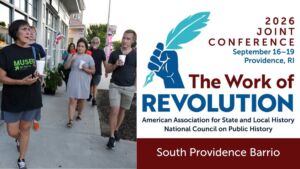
One of their popular programs is a walking tour of Broad Street in South Providence, one of the most active corridors of Latino life in Rhode Island. This tour is offered on the afternoon of Friday, September 18 during the AASLH/NCPH Joint Conference. While there, participants will encounter history as something that is still unfolding. Led by RILA, the experience brings together storytelling, food, place, and memory—drawing directly from RILA’s long-running oral history work.
Over the past three decades, Marta V. Martínez, RILA’s Founder and Executive Director, has collected stories from Latino residents across the state—stories shared at kitchen tables, in small businesses, at community gatherings. Those stories form the foundation of this tour. As they walk, participants will hear excerpts drawn from real lives: migration journeys, first jobs, storefront beginnings, moments of loss, and moments of celebration.
Along the way, the tour pause at neighborhood landmarks—eateries, bodegas, barbershops, and public spaces that carry deep meaning for the community. Participants may sample local foods, including the Dominican Chimi sandwich, not simply as a tasting experience, but as a way to understand how culture is carried through everyday life. (Food is not included in the tour fee. Martinez recommends bringing $25 for food purchases during the tour.)
This is not a scripted historical reenactment. It is a guided encounter with a neighborhood where history is visible in signage, language, music, and movement. It asks participants to listen closely, to notice what might otherwise be overlooked, and to consider how public memory is shaped not only by institutions, but by people.
For those attending the AASLH conference, this tour offers a chance to step outside the conference setting and into a living, breathing archive—one that continues to grow with every story shared.
Note: Preregistration is required. The tour is limited to 15 people so register now at https://aaslh.org/annualconference/2026-annual-conference/.)