By: Mackenzie Gardner, Outreach and Education Coordinator, C.H. Nash Museum at Chucalissa
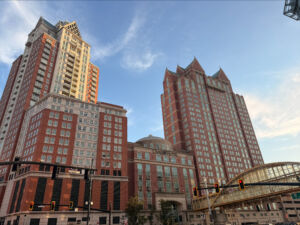
OmniProvidence Hotel – Photo Courtesy of the Author
When we think of those on the front lines of revolution, we do not typically include the librarian, the curator, or the historian.
The AASLH and the NCPH hosted a joint conference in September 2026 to explore a theme incredibly relevant to our professional climate: The Work of Revolution. Interested parties gathered from around the nation in Providence, Rhode Island to join the front lines of our current revolution – telling holistic histories in a sociopolitical climate that wants to bury them.
I am the Outreach and Education Coordinator at the Chucalissa Museum in Memphis, TN, and I see the struggles of our field every day. For this reason, I wanted to attend the AASLH/NCPH Joint Conference to learn from like-minded, determined professionals. My experience was made possible by the Cinnamon Catlin-Legutko Memorial Scholarship, which honors the legacy of a renowned museum director, author, and advocate. I read several books edited by Catlin-Legutko while working toward my MA in Museum Studies. When I learned that I had been selected as the scholarship recipient, I immediately pulled each of those books off of my shelf, awestruck by the significance of the award. I cannot express how grateful I am for the opportunity to take part in this monumental gathering.
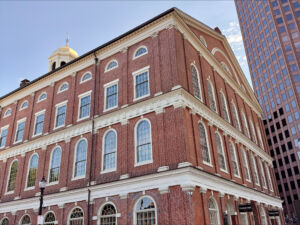
Faneuil Hall, Boston Freedom Trail – Photo Courtesy of the Author
What better way to kick off The Work of Revolution conference than by journeying along the Boston Freedom Trail. This pre-conference tour took attendees to several key locations of the American Revolution. We visited the Old North Church, the Paul Revere House, Faneuil Hall, the Old State House, and my favorite, the Old South Meeting House. The famed Boston Tea Party began in the Old South Meeting House, and I was delighted to see their recent cinematography project titled “Ruckus.” The tour taken by a horde of historians and museum professionals made for rich conversation and a great start to the conference.
I sought out sessions related to my current role at Chucalissa to take home new perspectives and strategies that will help our museum thrive. The first session I attended was titled “A Call for Solidarity: Building Coalitions,” and it highlighted the intersectionality of stewardship and how communities can support each other within the public history field. The opening keynote was then presented by Ned Blackhawk, Yale University professor and author of The Rediscovery of
America: Native Peoples and the Unmaking of U.S. History.
Perhaps my favorite session of the day was “Innovating Practice with the New Museum Educator’s Manual,” featuring some of the contributing authors and editor of the soon to be published edition of The Museum Educator’s Manual. The session highlighted new chapters on evaluation, accessibility, and representation. The speakers were inspiring, and while I eagerly await the publication of this text, more than one of their other book projects was available at the
Bloomsbury exhibit table (I bought four in case you were wondering).
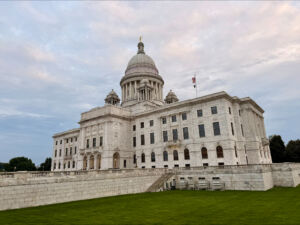
Rhode Island State Capitol – Photo Courtesy of the Author
Outside of sessions, I had the privilege of networking with other professionals in our field. I attended the Small Museum’s Luncheon, where the vibrant, fiery attitudes of small museum folk never fail to amaze me. We wrapped up the day with a special evening event. Constitution Day at the Rhode Island State Capitol offered a series of delicious Rhode Island food specialties along with after hours access to the building, museum, and library.
The remaining sessions were filled with practical solutions for everyday museum problems from program development to popular history to low budget renovations all the way to democracy. The “Doing History is Doing Democracy: Introducing AASLH’s History & Democracy Initiative” session explored the ways that we as public history professionals have a role to play in the preservation of not only history but also our democratic freedoms.
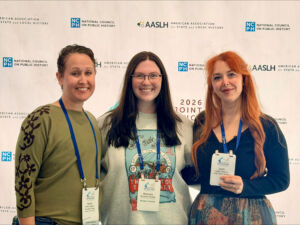
From Left to Right: Marty Gimson (Historic Sites and Program Manager, Beaver Dam) Mackenzie Gardner (Outreach and Education Coordinator, Chucalissa Museum), and Caty McKinnin (Assistant Curator, Sutter County History Museum) – Photo Courtesy of the Author
As the conference came to a close, I attended one final session, “Engaging the Public with Challenging History.” This topic is one that I have explored since walking into my first undergraduate history course. I have focused my education and career on learning and sharing the hard parts of history in a way that will be heard, even by those who don’t want to hear it. This session culminated nearly a decade’s worth of my own interests into a remarkable conclusion to
my experience at the 2026 AASLH/NCPH Joint Conference.
History isn’t meant to be palatable. History is meant to be whole, and that, my fellow changemakers, is the work of our revolution.
PS: Apply. Apply for the job, the scholarship, the fellowship, whatever it is. Just apply. The worst case scenario is that you don’t get a response. The best case scenario is that you end up in Providence with 1,500 public history professionals encouraging you to change the world.